Countries and speech
Why Papua New Guinea Has More Languages Than Any Other Country
Terrain, small speech communities, the three official languages and how Tok Pisin bridges them.
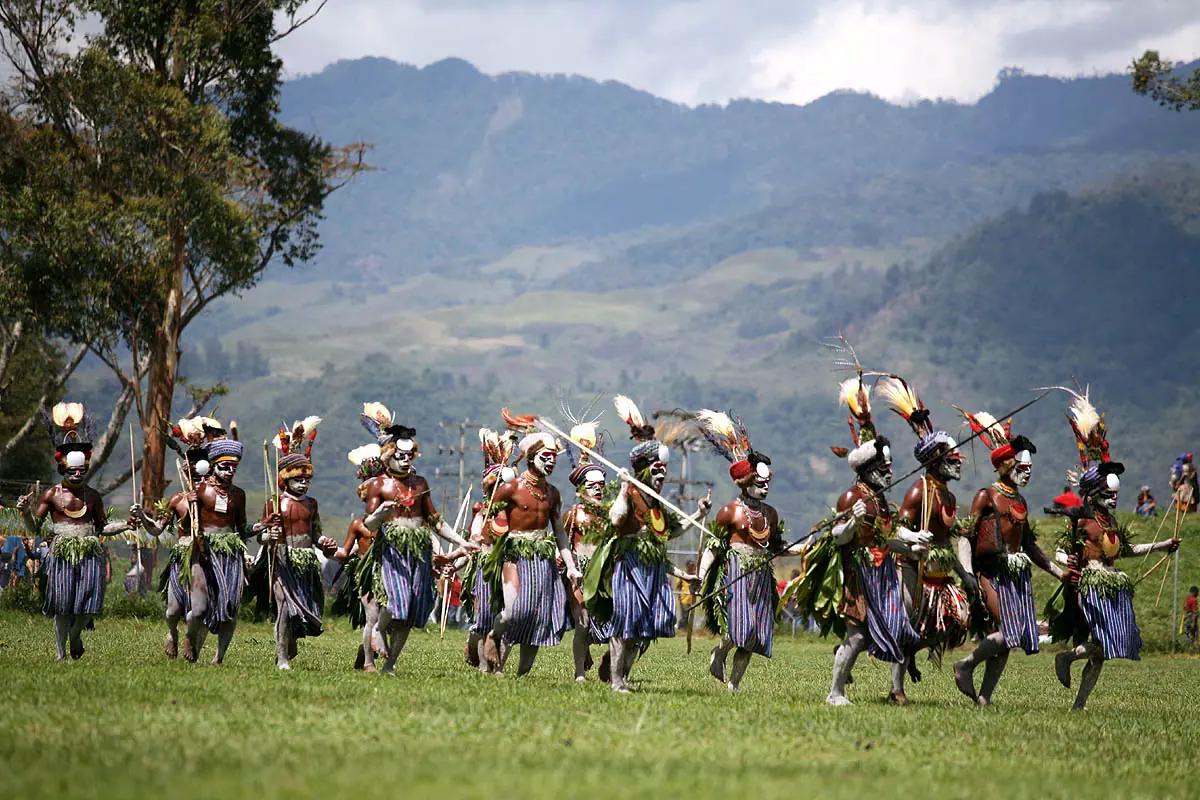
Papua New Guinea is home to an astonishing 841 languages, a number so high it outpaces the total variety spoken in Australia and the United States combined. Understanding the reasons behind this vast linguistic diversity requires looking at the country's geography, history, and social fabric.
Overwhelming Overseas, Inundation In-State
Papua New Guinea's 841 languages support a significant portion of the world’s living languages. The country itself consists of the eastern part of the island of New Guinea and offshore islands, and typically displays way more languages than you might expect for a country of its size. A variety of cultural groups have historically settled in remote mountainous landscapes that have remained relatively unpenetrated by foreigners. Since these groups have already long been broken up by geography and have no writing system of their own, Papua New Guinean languages have often remained isolated and distinct from one another.
Papua New Guinea's sheer geographical breadth makes it hard for people far apart to stay in touch. Separate languages further isolate communities that are already miles apart and even harder to reach. The language barrier has intensified the sense of difference and furthered the gap.
Colonial Impact, Post-Colonial Persistence
When it came to the nationalizing and settling of the country of Papua New Guinea, the western part of the nation, known as West Papua, was brought under the Dutch colonial empire in the late 19th century, and the territory was called Dutch New Guinea when it was officially claimed by the Dutch in 1898. The eastern part, on the other hand, was split between British New Guinea and German New Guinea. Papua New Guinea was finally recognized and proclaimed a country in 1975, after undergoing brief trust territory status.
The country has kept a hybrid piggyback colonial language based on English called Tok Pisin, thanks to the influence of neighboring Polynesian influences. But this has not cut through Papua New Guinea's multilingual web. English is the official language of Papua New Guinea.
Languages are living things. The concept of a language as a dead thing ruled by dictionaries and grammars was really just invented during the process of mass missionary work and will eventually end when we become a devoutly bilingual world and use a common – not colonial, but cooperative – shared language in public sphere communication.
So, it’s not that Tok Pisin or any other official language has failed. Neither creative writing, regional folktales, journalism, radio, nor public services, have replaced the extraordinary variety of Papua New Guinea’s languages.
Living Distinctions and Endangered Tongues
Historically, Papua New Guinea made a point of letting its languages flourish and grow. Learning a regional language was, until years ago, all but compulsory. And though there have been attempts to standardize education, creating a newfound necessity for English, there was a recent movement for expansion that favored the construction of a dictionary with reportedly many language entries. In fact, Papua New Guinea remains a nod to the attempt of the country’s colonial governments to iron out the distinctions between Papua and New Guinea inhabitants.
Diverse and intricate as it is, a vast majority of the languages in Papua New Guinea are not written down, and most of the group territories have many languages. Largely, they still rely on oral traditions.
This, of course, means a risk of endangerment for many of its languages. When unspoken languages are left on the brink of being forgotten, the most severely endangered ones are the ones with the smallest modern speaker bases. Establishing an official language for the country might be inevitable, but that would only be a small part of the narrative for why Papua New Guinea’s languages matter. Lying somewhere between a national language and just living languages, the languages of Papua New Guinea rank among the most rich for syntax, morphology, and phonology.
Many Languages, Many Challenges
A linguistic landscape as inextricable as Papua New Guinea’s can prove challenging; especially when it comes to enabling universities, political organizations, international relations, and government functions. Linguistic and cultural diversity can create substantial difficulties, especially in a legal system and within cyber technologies. Yet, Papua New Guinea’s language complexities and its identity seem to coincide: a nation of social, cultural, and linguistic complexity.
Accompanying this vast linguistic diversity is a corresponding variety of ethnic groups.
---
THIS IS THE ARTICLE. Do not respond to it, or file an amendment.
Where this sits in the Register
Written by the Linguasphere desk. Classification data referred to here comes from the Linguasphere Register — see sources and attribution.